
In this volume
Prologue
Prologue 0.1|Why This Map Is Needed
We stand at a distinct turning point in collective consciousness.
On one hand, a growing number of people are beginning to sense that reality is far more vast than what we were educated to believe. Meditation, psychedelic experiences, near-death experiences, spontaneous peak states—countless individuals are touching, in their own ways, dimensions that transcend the ordinary.
On the other hand, this era is also marked by fragmented spiritual information and rootless conceptual consumption. People are surrounded by narratives of "awakening," yet often find themselves lost in a jungle of terminology, unable to truly grasp: Where am I, exactly? Where am I going? Are my confusions personal failings, or necessary passages in the unfolding of consciousness itself?
This white paper, offered by Axis Mundi Gate, is not another "higher" theory. It is a coordinate system for orientation.
It does not define who is "more evolved." It creates no new hierarchy.
It does one thing only: to help those sincerely walking an inner journey recognize where they are on the map—and understand the meaning of that position within a larger landscape.
A map is not the territory. But when you are exploring unknown land, a map can keep you from losing your way.
Prologue 0.2|How to Use This Text
This is not a textbook that must be read from beginning to end.
You may:
- First glance at the four-phase summary table in Part Two to quickly form an overall impression;
- Or go directly to the phase that most resonates with your current confusion or longing;
- Or keep it as a long-term reference tool, reopening it at each major turning point of your life.
The path of consciousness evolution is not linear.
Most people do not "pass through" Phase I, "enter" Phase II, and then "graduate" to Phase III.
We often operate in multiple phases simultaneously:
- In meditation, glimpsing the boundless unity of Phase I;
- At work, competing with others and distinguishing right from wrong (Phase II);
- In community, experiencing deep connection and belonging (Phase III);
- In certain moments, suddenly feeling a clarity of being both independent and one, both rooted and transcendent—a signal of Phase IV.
The purpose of this map is not to label you, but to help you see:
That the confusion, the struggle, the longing, the breakthroughs—none of them are your "problems."
They are the natural rhythm of consciousness expanding.
Part One: Premises—Before Reading the Map
Before outlining the four phases, four foundational clarifications must be addressed. They are the ground upon which the entire model rests.
1.1 The Multidimensional and Participatory Nature of Reality
Reality is not singular or linear.
Conventional education tells us: the world exists objectively, and consciousness is its observer. Time is an arrow moving from past to future; events follow causal sequences.
This description is not "wrong"—but it is only one slice of reality. Like a two-dimensional shadow that cannot grasp the full form of a three-dimensional object.
A more complete understanding is this:
- Time is simultaneous: Past, present, and future exist concurrently, like frames on a film reel. What we call "now" is merely consciousness's focal point on that reel.
- Consciousness is participatory: We do not stand outside the world watching it. In each moment, we co-create the reality we are experiencing.
- Dimensions are superimposed: The physical world, energy fields, the domain of consciousness, the archetypal realm—different dimensions of reality coexist in the same space, like radio signals of different frequencies.
This is not mysticism. It is a recognition pointed toward by frontier physics (quantum theory, holographic universe theory), depth psychology (Jungian synchronicity), and millennia of contemplative traditions alike.
Any understanding of consciousness evolution must be grounded in this multidimensional, participatory ontology. Otherwise, we will only mistake "evolution" for "becoming better" within the same flat world—rather than recognizing it as the expansion and integration of perceptual dimensions.
1.2 The True Meaning of Unity: Integration, Not Dissolution
"We are all one"—this is perhaps the most frequently quoted sentence in contemporary spiritual discourse.
But unity has been widely misunderstood.
Misunderstanding One: Unity means the dissolution of individuality. As if enlightenment meant becoming a drop of water without boundaries in an ocean—until "I" disappears, leaving only "the whole."
Misunderstanding Two: Unity means everyone is the same. Difference is illusion, uniqueness is ego-clinging, and the ideal state is for all thoughts, emotions, and behaviors to converge.
These two misunderstandings have caused immense harm:
- People suppress their uniqueness, believing that having personal boundaries is "ego";
- Communities develop implicit pressures toward homogeneity;
- True integration is delayed, replaced by a floating, rootless experience of emptiness.
True unity—what we call "Integral Unity"—is entirely different:
Unity does not flatten individuals.
It allows each unique being to become an organ of the whole.
Consider the body: the liver is the liver, the heart is the heart. The liver does not try to become the heart; the heart is not ashamed of not being the liver. Each is fully what it is—yet together, they form an inseparable living organism.
Integral Unity means:
- I clearly know who I am, where my boundaries are;
- I also clearly recognize: my very existence participates in and contributes to a larger whole;
- This "wholeness" does not require the sacrifice of uniqueness—quite the opposite: it requires the full presence of every unique being.
This is a core characteristic of Phase IV consciousness.
1.3 Non-Duality: The Continuity of Spirit and Matter
Another common misconception within spiritual traditions is hierarchical dualism:
- "Spirit is high, matter is low";
- "Heaven above, earth below";
- "Enlightenment means transcending the physical body and returning to pure consciousness."
This is not non-duality. It is implicit dualism—merely with values reversed.
The true non-dual understanding is this:
Spirit does not oppose matter.
It expresses itself through matter.
Just as water can be liquid, solid, or gas—different forms, same essence.
The sacred and the ordinary are not two separate domains.
The sacred is not located somewhere beyond the ordinary. It is the true face of the ordinary when it is experienced fully.
This means:
- Practice is not about escaping the world, but entering it more completely;
- The body is not a prison for spirit, but the temple where spirit manifests;
- Material life is not something to be transcended, but the necessary medium through which Source experiences itself.
This understanding is the starting point for the entire philosophy of The Axis Mundi Path. It also returns us to the fundamental proposition of consciousness evolution:
Not moving from "low" to "high,"
But moving from separation to integration,
From fragment to wholeness.
1.4 Anchoring the Coordinate System: Four States of Collective Consciousness
In contemporary spiritual discourse, "collective consciousness," "group consciousness," "unity consciousness," and "holistic consciousness" are often conflated. To clarify the language system used by Axis Mundi Gate, the following distinctions are established:
I. Group Consciousness
Keywords: Task coordination · Division of labor · Information complementarity
The form of consciousness closest to "real-world collaborative interaction." Like a beehive or a project team, non-verbal coherence and functional differentiation emerge around a shared goal. Individuals maintain clear self-boundaries; friction and adjustment are part of the process.
Basis of operation: Shared goal + core frequency point (e.g., leader or vision)
II. Collective Consciousness
Keywords: Cultural resonance · Subconscious synchronization · Historical sedimentation
An energy aggregation current at the societal level—such as national consciousness, zeitgeist, religious identity. Individuals are often unconsciously influenced by it, mistaking "their own thoughts" for independently formed when they are in fact driven by the collective subconscious.
Distinction from Group Consciousness: Group consciousness is conscious collaboration; collective consciousness is unconscious immersion.
III. Holistic Consciousness
Keywords: Multidimensional integration · Deep synergy · Active alignment
This is the state of consciousness toward which The Axis Mundi Path is oriented.
The conscious entity, while preserving complete individual sovereignty and uniqueness, deeply recognizes itself as part of a larger whole and actively chooses inward alignment and resonant synergy.
It is not command-based uniformity, but a symphony of "I am willing to be resonated." Like an orchestra without a conductor—each musician masters their instrument, each listens to the whole, and the music emerges from collective listening.
Holistic consciousness is the wisdom born of walking through fragmentation. It is the integration of "having a self" and "being without self."
IV. Unity Consciousness
Keywords: Originally one · No separation, no distinction · Beyond self
This is the most source-level consciousness state among the four, the closest to "existence itself."
It is not "all beings becoming one"—it is "originally one": at the ontological level, there has never been separation. Not a later reunification, but a primordial state of never having been divided.
In Unity Consciousness, there is no need for collaboration, no need for communication—because there are, essentially, no "two" to collaborate.
It is the origin of consciousness, and its ultimate return.
It is not the goal of The Axis Mundi. It is the door through which consciousness returns home—after The Axis Mundi has completed its Mission
Four States of Consciousness: Relationship Summary
| Consciousness Type | Core Characteristics | Individual Boundaries | Mode of Operation | Axis Mundi Gate Positioning |
|---|---|---|---|---|
| Group Consciousness | Task coordination | Clear | Functional complementarity | Starting point of collaboration |
| Collective Consciousness | Cultural resonance | Blurred | Subconscious drive | Needs to be recognized |
| Holistic Consciousness | Multidimensional integration | Clear and aligned | Active resonance | Goal of The Axis Mundi |
| Unity Consciousness | Originally one | Dissolved | Non-dual manifestation | Ultimate return, not current path |
Part Two: The Four-Phase Model of Consciousness Evolution
2.1 Model Overview: Four-Phase Summary Table
| Phase | Name | Core Metaphor | Core Characteristics | Typical Challenges | Cultural Expressions (Examples) |
|---|---|---|---|---|---|
| I | Undifferentiated Source | Ocean without waves; unrun server | No individuality, no time, no duality; all potential unmanifest | Cannot "live" in this state; regression trap | Pre-natal consciousness; deep dreamless sleep; certain descriptions of "Nirvana" |
| II | Differentiation—Individuality and Duality | Droplet forming; program begins running | "I" and "world" separate; duality emerges; time-space experience begins | Loneliness, conflict, lost in binary judgment | Mainstream modern consciousness; religious fundamentalism; nationalism |
| III | Horizontal Unity—Oneness Within Separation | Waves converging; community forming | Reaching for unity within differentiation; emphasis on connection, love, belonging | Group attachment, implicit authority, unsteady sovereignty | 1960s–70s counterculture; New Age movement; utopian communities |
| IV | Sovereign Integral—The Beginning of the Axis Mundi Journey | Cell and body; individual instrument and symphony | Stable individual sovereignty + profound sense of oneness; becoming Axis Mundi | Requires continuous inner alignment; no existing social template | Scattered individuals, not yet scaled; a future coming into manifestation |
Important Note: These four phases are not "levels," not "ranks." They are different states of consciousness itself. A mature human being should be able to flexibly access different phase-states according to context—just as a musician can play different genres as needed.
2.2 Phase I|Undifferentiated Source
Definition & Core Characteristics
This is the original state of consciousness—
No matter yet, no individuality yet, no time yet.
Like an ocean before any droplet, river, or wave has differentiated.
Daoism names this Wuji (无极).
Vedanta names it Nirguna Brahman.
Western mystical traditions name it The Source.
In this state:
- No distinction between subject and object;
- No sequence of past, present, future;
- No "I," no "you";
- No right/wrong, good/evil, better/worse;
- All possibilities exist, yet none are experienced.
Common Misunderstandings & Clarifications
Misunderstanding 1: Phase I is the "goal" of practice—we should "return" there.
Clarification: Yes and No. Even though Phase I is the starting point and the destination. Just as an infant in the womb is perfect, yet the task of adulthood is not to return to the womb. The journey of consciousness is not regression, but carrying all the experience gained through differentiation back into the One for expanded integration.
Misunderstanding 2: Experiencing Phase I is enlightenment.
Clarification: Many people, through meditation, psychedelics, or near-death experiences, briefly touch the undifferentiated state of oneness. This is a real and precious experience—but it is only the beginning of the journey. Mistaking the experience of Phase I for the end is the most common trap of stagnation on the spiritual path.
Cultural Expressions
- Newborn consciousness
- Deep dreamless sleep
- "Dissolution experiences" described in certain traditions
- "Before the beginning of things" in Zhuangzi
The Gift This Phase Leaves Us
It lets us truly know: separation is not the final reality.
Beneath all identity, all roles, all labels, there is an indestructible layer of connection.
This memory is the homing beacon consciousness can never lose.
2.3 Phase II|Differentiation—Individuality and Duality
Definition & Core Characteristics
From Wuji, consciousness makes a "subtle deviation."
The ocean produces its first droplet.
Daoism says: Wuji gives birth to Taiyi; Taiyi gives birth to Taiji; Taiji gives birth to the Two Modes (Yin-Yang).
This means:
- Yin and Yang appear;
- Subject and object appear;
- The boundary between "I" and "world" appears;
- The body appears;
- Time and space appear.
This is where material experience truly begins.
In this phase:
- We learn to say "I";
- We learn to distinguish "mine" and "yours";
- We learn good and evil, right and wrong, beauty and ugliness;
- We experience love, and we experience hate;
- We establish rules, laws, ethics;
- We develop science, technology, art.
Separation is not a mistake. Without separation, there is no experience. Without experience, Source cannot know the infinite richness of itself.
Typical Challenges & Dilemmas
The great achievement of Phase II also brings its core difficulties:
- Loneliness: When I become "I," a pane of glass forever remains between me and the world.
- Conflict: My interests and your interests are often incompatible.
- Nihilism: If I am only this brief body, what is the meaning of life?
- The binary prison: We become habituated to understanding everything through right/wrong, good/evil, win/lose—forgetting that these concepts are tools, not reality.
Cultural Expressions
- Mainstream operating system of modern society
- Religious fundamentalism (absolutized good/evil dualism)
- Nationalism and identity politics
- Capitalist competition logic
- Traditional education systems
The Gift This Phase Leaves Us
Individuality. Boundaries. Autonomy. Creativity.
Without Phase II, we would forever be nameless droplets in the ocean.
We would never know who "I" am. We would never have a story of our own.
2.4 Phase III|Horizontal Unity—Oneness Within Separation
Definition & Core Characteristics
When individual consciousness develops to a certain point,
separation begins to feel insufficient.
You have built a successful career—yet one night you ask yourself: Is this all?
You have formed intimate relationships—yet still feel a certain inexpressible loneliness.
You follow society's rules, become a "good person"—yet feel life slipping through your fingers.
And so consciousness begins to seek unity again.
But this time, within a world that has already differentiated.
Typical Expressions of Phase III
In the mid-20th century, this longing erupted in large-scale collective movements:
- Counterculture (1960s–70s): Distrust of mainstream values, exploration of alternative ways of living.
- Sexual liberation: Attempts to break through possessiveness and jealousy in relationships, exploring the coexistence of love and freedom.
- Communal experiments: Building communities based on sharing rather than competition.
- Psychedelic exploration: Temporarily dissolving the boundaries of self through chemical means, experiencing oneness.
- New Age spirituality: Integrating Eastern contemplative practices with Western psychology, emphasizing love and light.
This is Horizontal Unity.
Its core achievement:
People experienced, for the first time, that we are not isolated individuals.
Love does not have to be possessive.
The body can be sacred.
Spirituality can return to everyday life.
Achievements & Limitations of Phase III
Achievements:
- Broke through the overly rigid individualism of Phase II;
- Made "unity" a tangible, experienceable reality again;
- Provided the necessary collective consciousness foundation for Phase IV to emerge.
Limitations:
When unity exists only at the collective level, individual sovereignty easily disappears.
Thus we observe:
- Implicit authority: Communities that proclaim "we are all one" often develop spiritual authorities more subtle—and more difficult to question—than mainstream society;
- Emotional entanglement: "Unconditional love" becomes a veil masking healthy boundaries and authentic conflict;
- Group pressure: To maintain the appearance of "unity," individuals suppress authentic feelings and opinions;
- Spiritual dependency: Projecting "higher consciousness" onto teachers, gurus, community leaders—repeating Phase II's pattern of authority worship, merely changing the object.
Phase III's fundamental unfinished task is this:
Unity has been remembered again,
but the axis still lies outside.
2.5 Phase IV|Sovereign Integral—The Beginning of the Axis Mundi Journey
Definition & Core Characteristics
Phase IV is not the negation of Phase III—it is its maturation and completion.
It answers the question Phase III could not resolve:
How can one maintain absolute individual sovereignty and uniqueness,
while remaining in deep, direct connection with all beings and with Source itself?
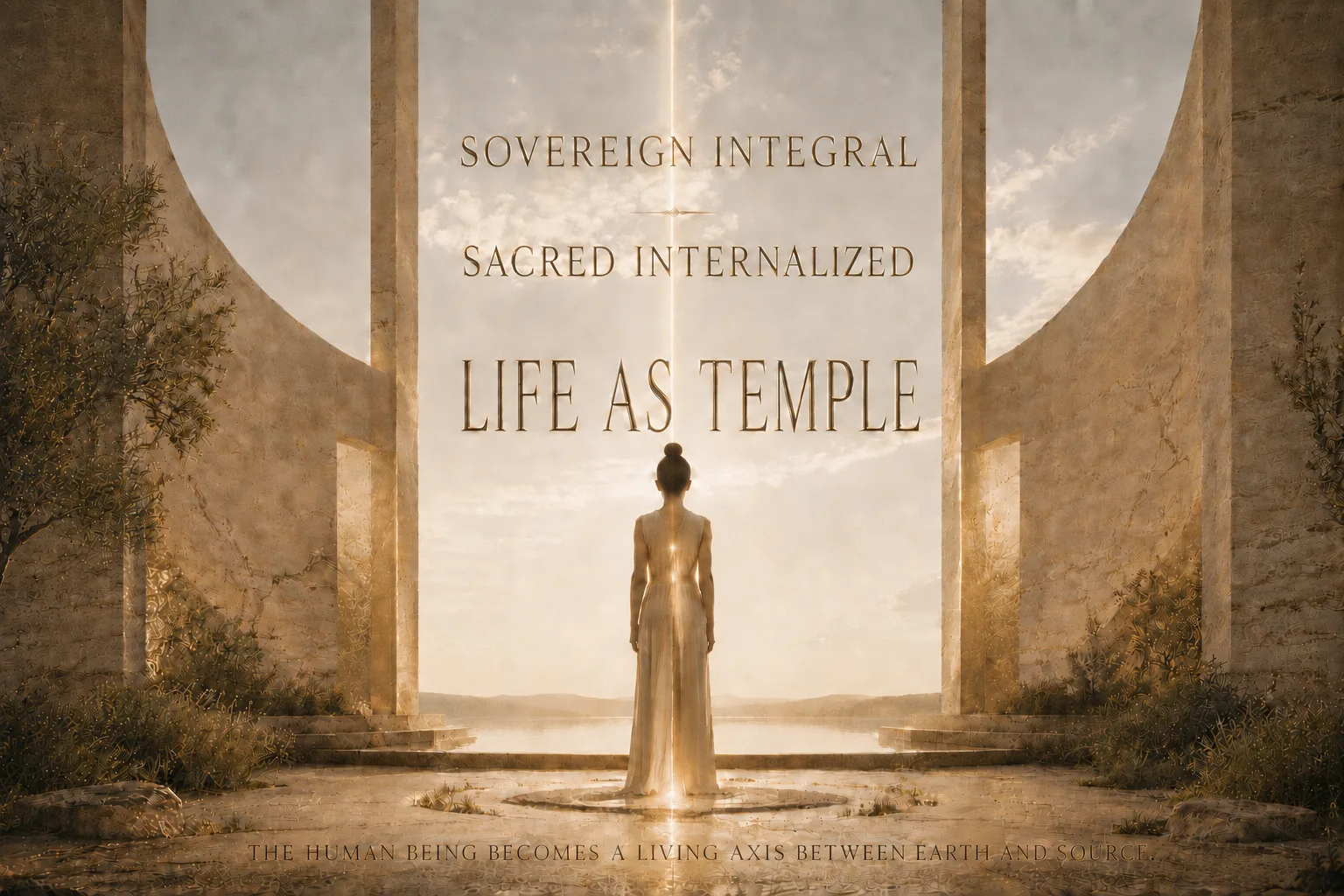
The consciousness state of Phase IV, we call "Sovereign Integral." In Daoism, this is known as "Tian Ren He Yi" (天人合一)—Heaven and humanity united as one.
Its core characteristics are:
1. Sovereignty
- I know who I am; my boundaries are clear and fluid;
- I do not need to depend any external authority to confirm my worth;
- My inner axis is stable, unmoved by external evaluation or collective emotional currents.
2. Integral
- I simultaneously know, deeply: I belong to a larger whole;
- My uniqueness is precisely the uniqueness the whole requires;
- I do not need to dissolve myself to experience oneness—it is precisely in fully becoming myself that my connection to the whole is most real.
3. Verticality
- My connection is not only horizontal (with others, with community);
- It is also vertical (with Earth, with Source);
- I become a living conduit: letting the energy of Source flow through me into the material world.
4. Embodiment
- I know: the body is the temple where consciousness manifests.
- Wisdom is not only known—it is lived into every cell of the body.
- It lives through me—
in each breath, in every posture, in each small choice.
Core Metaphors
Metaphor One: The Cell and the Body
A liver cell:
- Clearly knows itself as a liver cell, not a heart cell, not a brain cell;
- Is faithful to its function, does not try to become something else;
- Maintains continuous communication with the whole body, receiving signals from the whole, contributing its own output;
- The more fully it becomes itself, the more it contributes to the health of the whole.
This is Sovereign Integral.
Metaphor Two: The Symphony Orchestra
An orchestra without a conductor:
- Every musician masters their own instrument;
- Every musician simultaneously listens to the whole;
- No one issues commands—yet the music emerges naturally from collective listening;
- Difference is not eliminated; difference is integrated into harmony.
This is Sovereign Integral.
Metaphor Three: Small States with Few People
Laozi wrote in the Dao De Jing:
Small states with few people…
Neighboring states may be within sight,
The sounds of their chickens and dogs within hearing,
Yet the people may grow old and die without having exchanged visits.
Generations of commentators have interpreted this as advocating isolation and backwardness.
But another interpretation is being rediscovered by contemporary consciousness evolution:
"Small states with few people" depicts not isolation, but the natural condition of sovereignty matured:
- Every community (even every individual) is a self-sufficient center;
- No need to rule, no need to be ruled;
- Each "sees" the other—aware of their existence;
- Yet there is no need to "exchange visits"—no dependency, no control;
- Connection is the result of resonance, not the fulfillment of function.
This is the social vision of Phase IV.
Fundamental Distinctions Between Phase IV and Phase III
| Dimension | Phase III: Horizontal Unity | Phase IV: Sovereign Integral |
|---|---|---|
| Individual Boundaries | Blurred, seeking dissolution | Clear and fluid |
| Relationship to Authority | Prone to implicit authority attachment | No attachment; equal resonance |
| Experience of Oneness | Achieved through self-dissolution | Achieved through fully becoming oneself |
| Motivation for Action | Longing to be accepted, to be loved | Natural expression of inner axis |
| Conflict Handling | Avoids conflict to maintain "unity" facade | Authentic expression; integration through difference |
| Spiritual Authority | Teacher, guru, leader | Each person is their own authority |
Core Challenges of This Phase
Phase IV is a consciousness state coming into manifestation; it has no ready-made social templates.
Thus, its challenges are also new:
- Loneliness: When you are not attached to any group, any authority, you must face the open space that genuine inner independence brings. This is not the "longing for connection" loneliness of Phase II, but the unfamiliarity that comes in the early stages of Phase IV sovereignty maturation.
- Lack of Reference: It is difficult to find others who are already stably living this state. You must become a first-generation pathfinder.
- Continuous "Alignment" Work: Phase IV is not a permanent "enlightenment" achieved once and for all. It requires sustained practice—refinement of the body, clearing of energy channels, settling of inner noise. This is a sustainable path of practice, not a one-time peak experience.
- The Challenge of Materialization: How to stably manifest this high-order consciousness state in daily life, work, relationships, and creative expression? This is the core curriculum of Phase IV, and the fundamental question The Axis Mundi Path seeks to answer.
The Gift of This Phase
- True freedom: No need to please the world, no need to oppose the world. Your relationship with the world evolves from the twin prison of dependency/counter-dependency into mutually nourishing ecological co-creation.
- True connection: When you are no longer afraid of losing yourself, you can give love that is fully real. Intimacy in Phase IV is resonance and celebration between two sovereign individuals—not mutual filling of lack.
- True creation: When your inner axis is stable, your action is no longer about "proving yourself" or "saving others." It is Source expressing itself through you. This is creation in its most effortless state.
[Important Clarification: The Fundamental Distinction Between Sovereign Integral and Unity Consciousness]
The "Sovereign Integral" reached in Phase IV is not the same as source-level "Unity Consciousness."
Unity Consciousness is the ontological state of original oneness—without division, without distinction, without self. It is the origin of consciousness and its ultimate return. In Unity Consciousness, individuality dissolves into the Source; there is no "collaboration" or "alignment" because there are, fundamentally, no two.
Sovereign Integral is the state of completion and maturity that consciousness achieves at the individual level, after undergoing differentiation and refinement. It retains clear individual boundaries and sovereignty, while deeply perceiving itself as part of a larger whole and actively choosing inward alignment and resonant synergy.
Distinguished through metaphor:
Unity Consciousness: Ontological original oneness, individuality dissolving into Source. Comparable to the Buddhist concept of Nirvana Without Remainder (Anupādisesa-nibbāna) —a drop of water that has always belonged to the ocean; returning is its very nature.
Sovereign Integral: The mature state of consciousness completing integration at the individual level—possessing autonomous self-awareness, yet dancing with Heaven and Earth. Comparable to the Daoist Tian Ren He Yi (Heaven and Humanity as One) —a drop of water that, over the long journey of its birth, has traversed a thousand mountains and valleys, carrying the abundance gathered along the way, and has finally become a river that can flow of its own accord.
This river will, in the end, return to the ocean and reunite with Unity Consciousness—but that is not the problem this path seeks to solve, nor is it within the scope of this white paper.
The "Axis Mundi Roadmap" as spoken of by Axis Mundi Gate is the roadmap of practice that departs from Sovereign Integral and moves toward Holistic Consciousness.
It does not deny the ultimacy of Unity Consciousness.
It simply knows:
Before returning home in glory,
One must first weave the robe.
Part Three: Deepening & Clarifications
3.1 Non-Linearity: Spiral, Cycle, and Leap
The most important clarification: This is not a linear upgrade model.
Consciousness evolution is not like leveling up in a game. We do not one day permanently "become" Phase IV and leave all previous phases behind forever.
A truer image is spiralic:
- You may experience the non-differentiation of Phase I in meditation;
- Operate within the efficiency and competition of Phase II at work;
- Long for the fusion and connection of Phase III in intimate relationships;
- Glimpse the sovereignty and oneness of Phase IV in moments of clarity.
Maturity is not residing exclusively in the "highest" phase.
Maturity is possessing a more complete palette of consciousness—
Knowing when to use which color,
And being able to move fluidly between them according to context.
3.2 This Is Not a Hierarchy: Clarifying the Central Misunderstanding
This is where this model is most easily misunderstood—and where we must clarify repeatedly:
Describing difference is not establishing hierarchy.
Describing the difference between an infant and an adult is not saying the adult is "superior." The adult is merely more complex, more functionally differentiated—yet the infant has its own integrity and perfection.
Likewise:
- Phase I has its irreplaceable sacredness;
- Phase II has its irreplaceable creativity;
- Phase III has its irreplaceable relationality;
- Phase IV has its irreplaceable integration.
A healthy human being should be able to access different consciousness states according to contextual need.
Misreading the four-phase model as a hierarchy is, itself, a classic expression of Phase II binary thinking.
True Phase IV consciousness has no need to devalue any phase to confirm its own worth.
3.3 Frequently Asked Questions
Q1: Is this model "Spiritual Darwinism"? Is it saying some people are more "evolved" than others?
A: No. This model describes types of consciousness states, not ranks of human beings. The same individual may exhibit different phase-states in different contexts. Using it to label people or judge others is a misuse.
Q2: Phase IV sounds lonely, without community belonging. Is this really "evolution"?
A: Phase IV is not without community belonging—it is not dependent on community belonging to confirm self-worth. Phase IV individuals are capable of deeper, more authentic connection than Phase III, precisely because this connection no longer arises from lack and dependency, but from abundance and choice. The community of Phase IV is a resonance network of sovereign individuals, not a fusion collective that dissolves individuality.
Q3: I have experienced the non-differentiation of Phase I, and the love and connection of Phase III. But Phase IV sounds abstract. How do I know if I am operating in Phase IV?
A: A simple self-inquiry: When you are in conflict with others, or when your views are not accepted by a group, what is your first inner response?
- "I must be accepted" → Phase III;
- "You are all wrong" → Phase II;
- "I do not need anyone's approval, nor do I need to prove anything—yet I am still willing to listen and understand" → This is a signal of Phase IV.
Epilogue: The Map Is Not the Territory
4.1 From Cognition to Experience—An Invitation
The words you are reading now are the map.
A map can help you locate yourself, navigate, understand your coordinates.
But the map is not the territory itself.
The real journey is never on paper.
Phase IV consciousness cannot be attained through "understanding" alone.
It requires:
- Refinement of the body: energy channels clear enough to carry higher-frequency consciousness;
- Inner axis stabilization: repeatedly returning to the still center amidst storms;
- Daily practice: bringing the sacred into every ordinary moment;
- Integration Time: allowing peak experiences to settle into sustainable states of being.
4.2 Further Reading & Subsequent Works
This white paper is the first volume of Axis Mundi Gate's philosophical system.
It focuses on answering one question: "Where are we?"
Subsequent works will address, respectively:
- Volume II: The Axis Mundi Roadmap: A Universal Map of Direct Connection
- As fourth-stage consciousness gradually stabilizes, how does an individual embody this path through the body, breath, relationships, and work? How can the “Axis of Heaven and Earth” move from an idea into a lived path—one that can be practiced, examined, and continually refined?
- Volume III: The Axis Mundi Network—Nodes and Ecology of a New Civilization
As more individuals cultivate a stable inner axis along the Axis Mundi Roadmap, what new forms of social structure may emerge between human beings? How can communities arise that require no sacrifice of sovereignty? How might “small-scale, resonance-based networks” become a sustainable structural option within contemporary civilization?
Now, this map is placed in your hands.
How you use it is your own sovereignty.
Axis Mundi Gate · Philosophical Framework White Paper 01
First Edition: February 2026
Copyright: © Axis Mundi Gate. This text may be shared in full by any means. No commercial use. No modification of content.
Appendix: Glossary
| Term | Chinese | Definition |
|---|---|---|
| Axis Mundi | 天地之轴 | The Living Axis connecting Earth and Source. Mythologically expressed as sacred mountains (Kunlun, Olympus, Sinai, etc.); individually expressed as humanity's capacity to become a "living axis" once more. |
| Sovereign Integral | 主权合一 | The core consciousness state of Phase IV: simultaneously possessing clear individual sovereignty and profound perception of oneness. |
| The Axis Mundi Roadmap | 天地之轴地图 | The roadmap of practice emerging from Phase IV consciousness: stabilizing, and materializing the state of Sovereign Integral. |
| Horizontal Unity | 横向合一 | The characteristic consciousness state of Phase III: experiencing oneness through connection between individuals, yet without stabilized individual sovereignty. |
| Undifferentiated Source | 无极·未分化的一体 | Phase I consciousness state: no individuality, no time, no duality; all potential unmanifest. |
| Differentiation | 分化 | The core process of Phase II: separating individuality, time, space, and binary structures from the undifferentiated whole. |
| Unity Consciousness | 合一意识 | Ontological original oneness, without division, distinction, or self. The origin and ultimate return of consciousness. Not the goal of The Axis Mundi Path. Comparable to the Buddhist concept of Nirvana Without Remainder. |
| Holistic Consciousness | 弘一意识 | The state of consciousness toward which The Axis Mundi Path is oriented: under the premise of preserving complete individual sovereignty, actively aligning, multidimensionally integrating, and synergizing deeply. |
| Collective Consciousness | 集体意识 | Energy resonance at the societal level; individuals are often unconsciously immersed in it without recognition. Examples include national consciousness, zeitgeist, religious identity. |
| Group Consciousness | 群体意识 | Task-oriented collaborative con-sense; individuals maintain clear boundaries, forming functional complementarity based on shared goals. |
References & Influences
- Dao De Jing, Zhuangzi, Classic of Mountains and Seas
- Ken Wilber: A Brief History of Everything, Integral Psychology
- Spiral Dynamics: Clare W. Graves, Don Beck, Chris Cowan
- C.G. Jung: Collective unconscious, synchronicity
- James Mahu: The Sovereign Integral
- Anonymous witnesses from contemplative traditions across millennia